

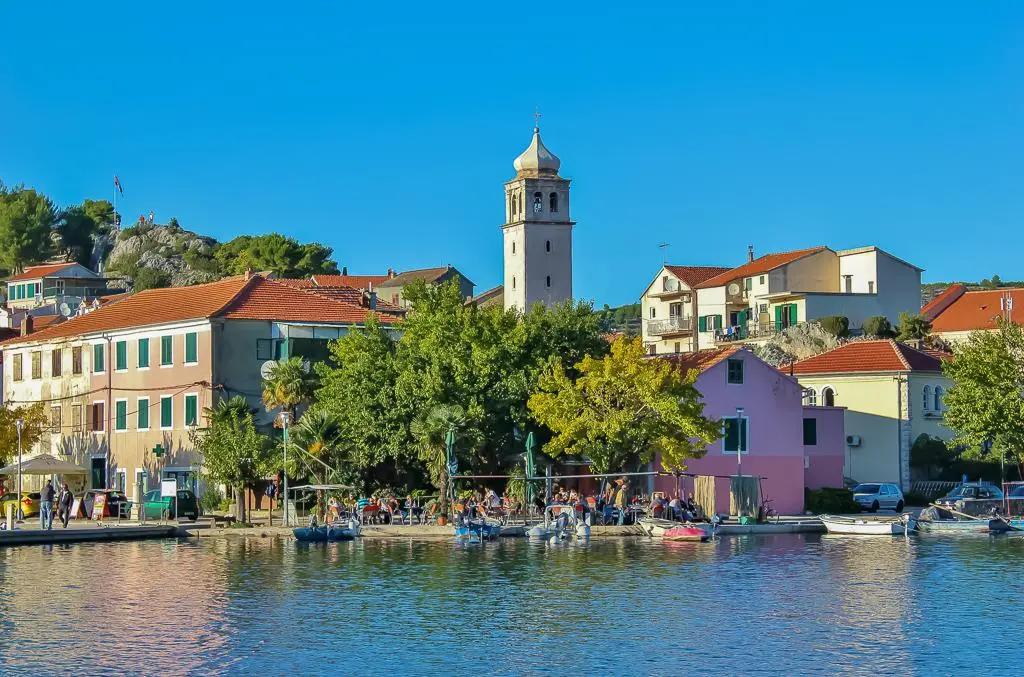
Thanks to ingredients sourced from both the river and the sea, as well as the fertile fields of the Skradin hinterland, Skradin is an unparalleled gastronomic mecca. It is famous for its top-tier restaurants, which feature the equally renowned Skradin risotto and Skradin cake as their signature specialties. However, Skradin risotto is a dish you won't always be able to order, as it is traditionally prepared for 8 to 12 hours, depending on the size of the pot. It is only ready when the meat has completely "melted" and blended with the rice, and it originally emerged as a wedding dish. The Skradin cake—flourless, rich in walnuts, and flavored with traditional Skradin rose liqueur—also owes its origins to Skradin's wedding customs. Legend has it that in the past, brides would bake it on the eve of their wedding night to impress the groom and prove their culinary skills.
Skradin, or ancient Scardona, was founded by the Illyrian tribe of the Liburnians in prehistoric times. The Romans turned it into a municipality and an important trading port; it was of vital importance to the noble Šubić Bribirski family, it was destroyed by the Avars, and conquered alternately by the Ottomans and the Venetians. Due to its strategic position on major routes, Skradin's greatest value lay in its port, and with the development of tourism in the last century, the Skradin port has become an essential nautical hub whose reputation grows with every new visit from celebrities and public figures from all over the world. Sometimes you might run into them while strolling through the picturesque streets of Skradin that lead to the Turina fortress, which offers a fantastic view of the town and its surroundings. On top of all this, Skradin also boasts a well-maintained town beach where you can experience swimming in a river, which is quite different from swimming in the sea.
Two plants have firmly taken root in Skradin. The first is the white mulberry, whose leaves feed silkworms—in the 19th century, Skradin was the sericulture and silk-producing center of Dalmatia, of which only trees with lush canopies remain, in whose shade you can enjoy, for example, a slice of Skradin cake. The second is the jujube—a fruit long ago brought from China that found an ideal microclimate in the Skradin region; you will see it adorning almost every garden and yard.
The favorite and most frequent entrance to Krka National Park is the one from the Skradin side, which can be reached by boat directly from Skradin, and the proximity of the attractive Skradinski Buk waterfall, which bears the town's name, is another reason to visit. Below that waterfall, the first alternating current hydroelectric power plant in Europe was put into operation back in 1895, and fans of industrial heritage can visit the Museum of Old Cars in Scardona Park after their trip to the national park. For history and archaeology enthusiasts, just a 15-minute drive from Skradin lies an archaeological site of exceptional importance—Bribirska Glavica, also known as the "Croatian Troy" due to its prehistoric, ancient, and medieval layers.


