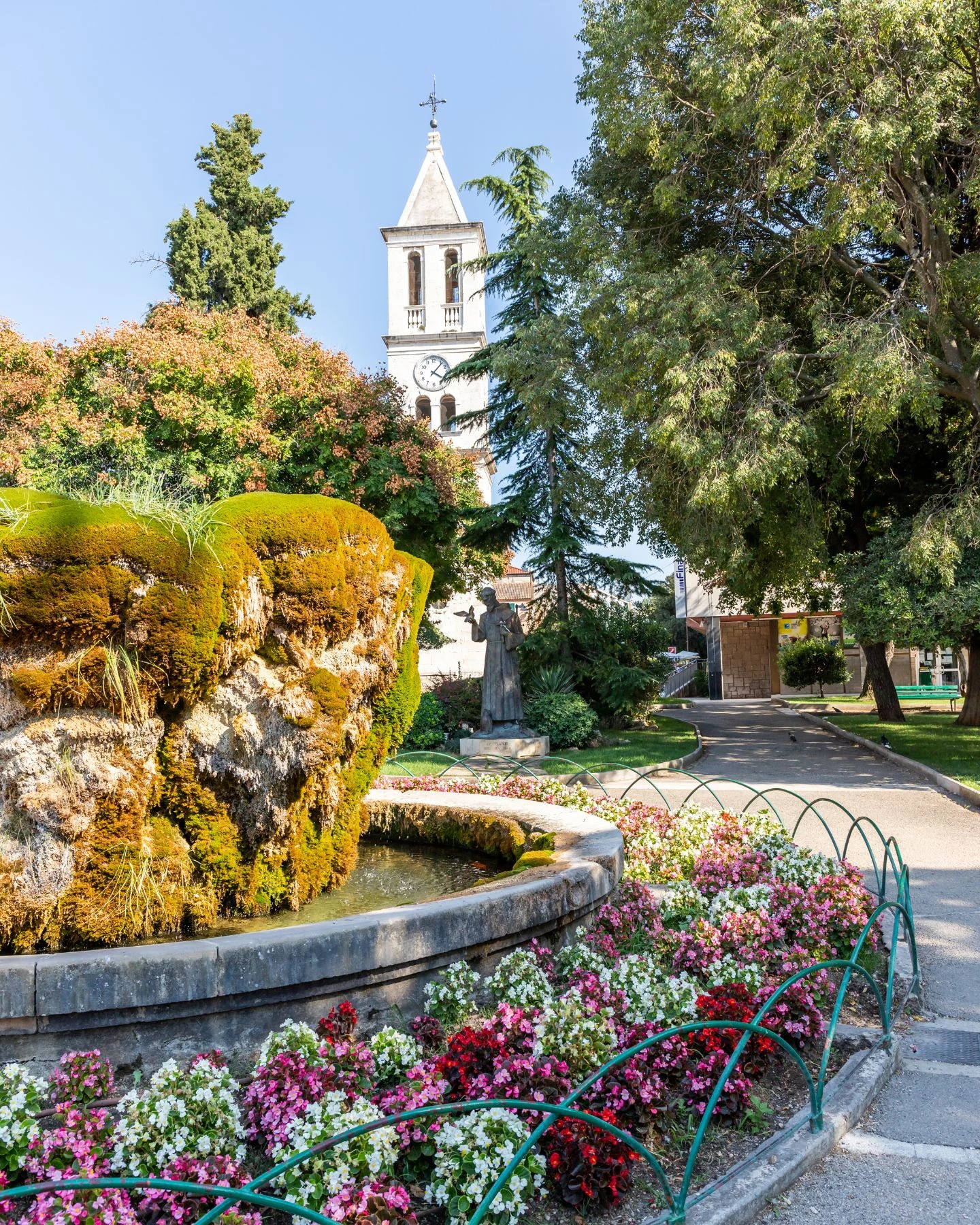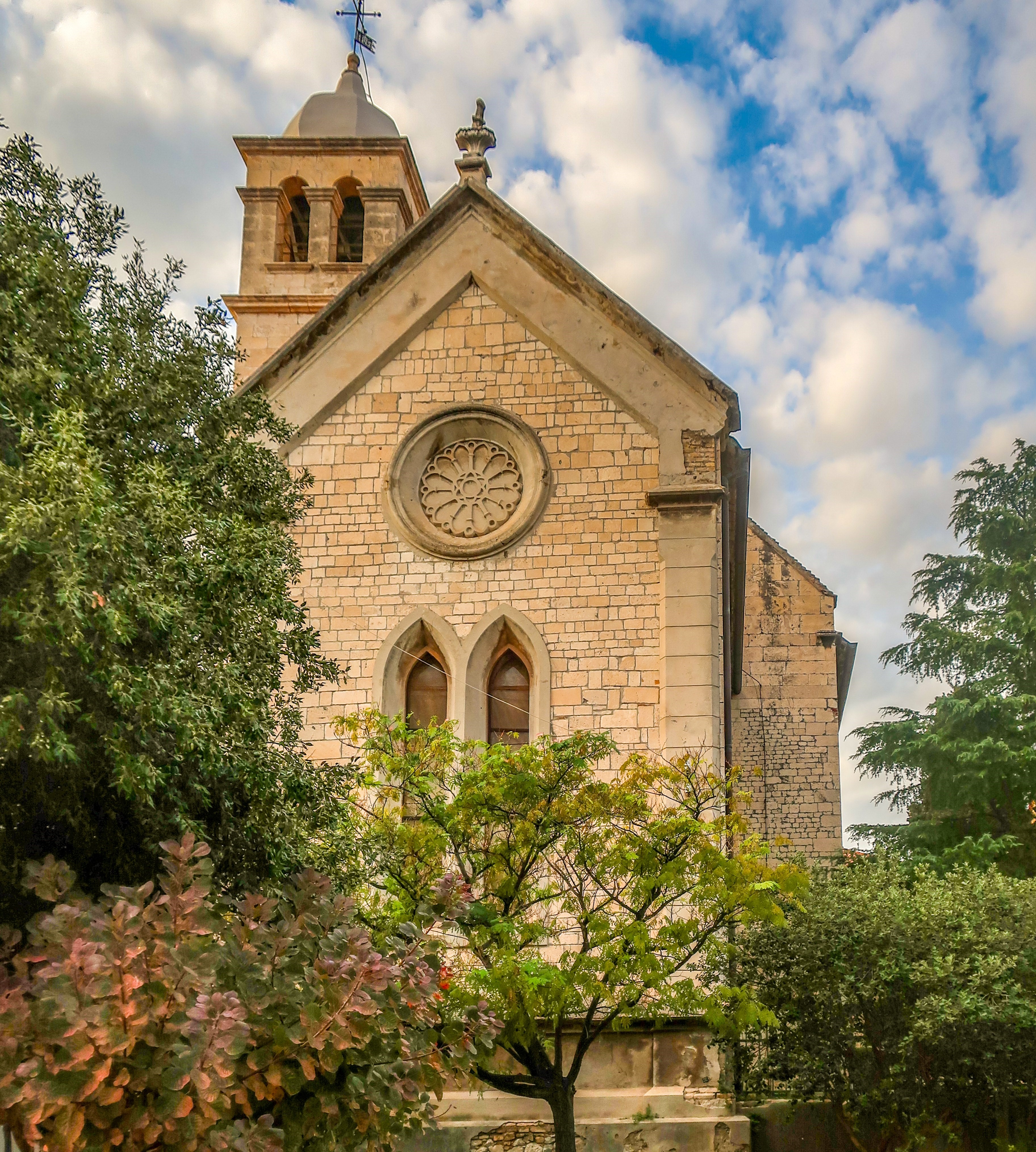
Few cities can boast the wealth of sacred sites that Šibenik possesses. It is a city with 24 churches, two of which are still in active religious use, while six have been repurposed for other functions today.
St. Barbara's
The Church of St. Barbara is a monument of Gothic architecture. This single-nave building dates back to around 1400. Above the main entrance, a Gothic niche features a sculpture of St. Nicholas, the work of the Italian master Bonino da Milano. On the northern wall, there is a Gothic window with a sculptural relief in its lower section, commissioned as a votive offering in 1419 by a Šibenik physician named Marko.
It is a unique example of a medieval relief depicting a physician on the eastern Adriatic coast.
Today, the Church of St. Barbara houses a small ecclesiastical museum displaying the most valuable artworks from the 14th to the 17th centuries.
St. John's
The Church of St. John is a Gothic-Renaissance structure built in the 15th century under the name of the Church of the Holy Trinity. The staircase along the southern side of the church is the work of the renowned Šibenik builder Ivan Pribislavić and is decorated with bas-reliefs.
At the base of the bell tower is a Renaissance window, the work of Nikola Firentinac, topped by a relief of a lamb with an angel with outstretched wings beneath it. These reliefs are masterpieces of Dalmatian medieval architecture. Also of interest is the bell tower, which houses a Turkish clock with a single hand, brought from Drniš after the Turks abandoned the town in the 18th century.
The dome of the bell tower was removed in 1862 following a strong earthquake.
St. Chrysogonus'
The Church of St. Chrysogonus is the oldest preserved sacred building in the city, dating back to the 12th century. It was built in the Romanesque style. It served as a place of worship until World War II, during which it was heavily damaged.
Following restoration, it became an exhibition space for the Šibenik City Museum and is now the St. Chrysogonus Gallery.
Holy Cross
The Church of the Holy Cross was built in the early 17th century from white hewn stone and dominates the central part of the Dolac district. The small church is adorned with a large rose window featuring carved medallions of the 12 apostles.
The construction of the church was initiated by the Confraternity of St. Mark, whose efforts led to the acquisition of the organ in 1776.
Our Lady Outside the City
The Church of Our Lady Outside the City was built on the site of a medieval cemetery that housed the small church of St. Cosmas and Damian (1452).
Following the establishment of the Varoš parish in 1604, the old church was adapted and expanded, with the construction of the new stone church completed in 1740. Shortly thereafter, a bell tower was built and connected to the church by a small bridge. The city cemetery, which was located in front of and around the Church of Our Lady Outside the City, was abandoned in 1828.
Holy Spirit
The Church of the Holy Spirit is located in the city center on Dinko Zavorović Square and was built in the 17th century according to the design of Antun Nogulović. The church is adorned with a beautiful stone facade featuring a stunning Baroque-style rose window.
New Church
The New Church is a Renaissance temple dating from the turn of the 15th to the 16th century. Nikola Firentinac is mentioned as one of the builders; his works, the stone sculpture "Pietà" and the relief "The Deposition of Christ," are carved into the lower part of the bell tower. The ceiling paintings in the church were created by local artists Mondella, Sisanović, and Bojković.
The upper parts of the walls are decorated with frescoes by Šibenik painters from the first half of the 17th century.
St. Nicholas
The Church of St. Nicholas was built in the 17th century in the Baroque style. In addition to several tombs, it houses models of sailing ships as votive offerings. Its facade ends in a bell gable, and the lower sections are articulated by windows and a portal with simple frames. Inside, the coffered ceiling panels feature figures of saints and portraits of donors in folk costumes, accompanied by inscriptions bearing their names.
St. Elizabeth
The Church of St. Elizabeth dates back to the 16th century and is located in the Crnica district. It is believed that the remains of old structures were found around the small church at the end of the last century, where, according to legend, King Béla IV took refuge while fleeing from the Tatars and Mongols. After World War II, the church was completely restored, and a Parish Pastoral Center was added. The Church of St. Leopold was built next to the Church of St. Elizabeth, making it the first religious building constructed after the war.
Dormition of the Mother of God
The Church of the Dormition of the Mother of God was built on the site where the Templars resided in the 12th century. It is a Baroque structure dating from the 17th and 18th centuries. Until the beginning of the 19th century, it was the Catholic Church of the Holy Savior and belonged to a Benedictine convent. By Napoleon's decree in 1810, the church was ceded to the Orthodox Bishop Benedikt Kraljević. The church is distinguished by its early 18th-century Baroque bell tower, the work of local master Ivan Skoko.
St. Gregory
The Church of St. Gregory is located on the oldest street in Šibenik, Juraj Dalmatinac Street, where his home is also situated. This small church, which features Gothic stylistic elements, houses a permanent thematic exhibition titled "Juraj Dalmatinac and His Work Outside Šibenik."
St. Dominic
The Church of St. Dominic is located on the western coast of the city. Until 1910, it was a Renaissance building, but it subsequently took on Gothic stylistic characteristics.
The interior of the church houses two valuable wooden altars, the tomb of the Šibenik bishop Arrigoni, and an organ built in 1818 by master Gaetano Mascatelli.
St. Francis
The Church of St. Francis was built in the second half of the 14th century on the far southeastern edge of the historic city center. The church is a spacious, single-nave Gothic building devoid of decorative architectural elements. In the 15th century, the Chapel of the Holy Cross was added to the north side, and the presbytery and sanctuary were remodeled. The main entrance on the facade features a stone frame in a Gothic style, and remnants of 14th-century frescoes can be seen in the lunette. The Chapel of the Holy Cross houses an organ built in 1762 by the renowned instrument maker Petar Nakić.
Part of the architectural complex of the Šibenik Conventual Franciscans, the monastery dating back to the 14th century is located on the south side of the church. Because cultural and historical artistic treasures have been collected there for centuries, the monastery today serves as a repository for a large portion of the city's monumental heritage.
The monastery library is notable for its collection of 140 incunabula and a collection of manuscript codices. It also houses the "Šibenik Prayer," one of the oldest Croatian linguistic and literary monuments, written in the Latin script around 1375.
St. Lawrence
The Church of St. Lawrence was built in the second half of the 18th century for the Franciscan order. The facade, which ends in a gable, features a profiled portal with a modest Baroque lintel. A small sculpture of St. Lawrence from 1720 is placed in the tympanum of the side entrance.
Beneath the facade, in the depth of the northern wall, a grotto of Our Lady of Lourdes has been created. Opposite the church is a Franciscan monastery from 1650, and its main building is the Foscolo Palace, the finest example of representative residential architecture in 15th-century Šibenik—the era of Florid Gothic and master Juraj Dalmatinac.